Last updated: 3rd June 2026
What's new this version: Refreshed for the May 2026 Andromeda updates. Updated EMQ benchmarks. Added internal links to deeper tracking guides.
A 15-step checklist covering tracking, creative, targeting, structure, and budget. Roughly an 8-minute read. Jump to any section using the table of contents below
If you're running ads on Facebook today, you've probably noticed something fundamental has shifted.
What used to work no longer works the same way.
Since Meta's Andromeda system launched and the platform doubled down on automation, success with ads in 2026 is less about tactical hacks and more about foundational principles executed correctly.
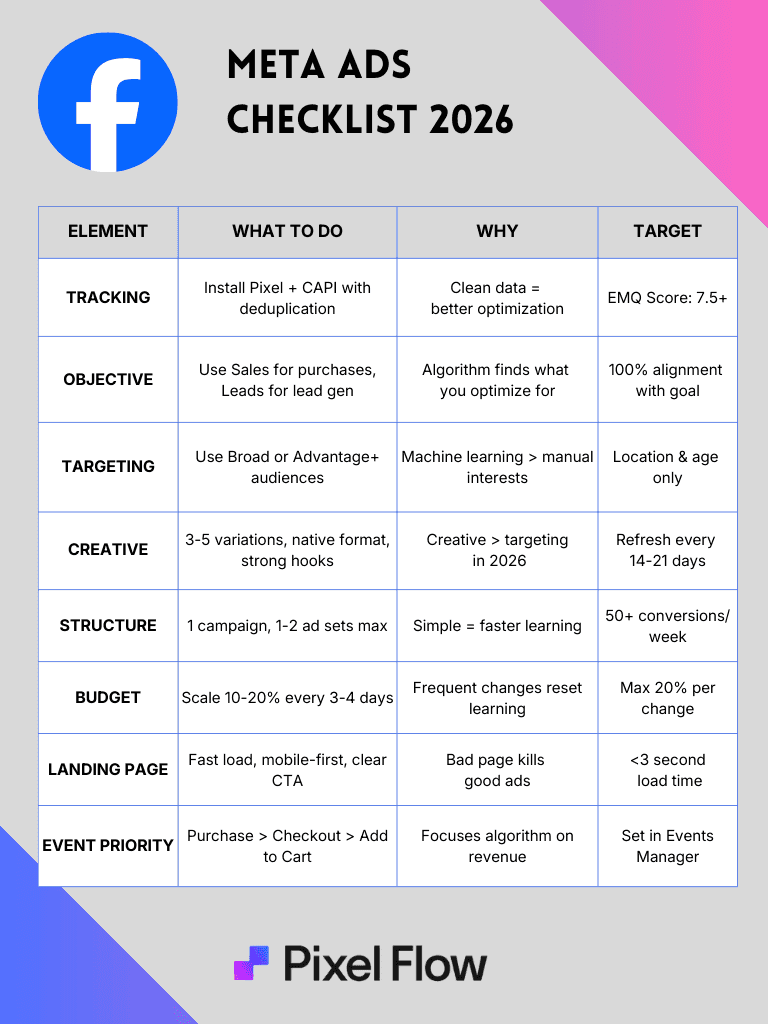
This checklist breaks down what actually matters now, why each element impacts performance, and how to implement it properly.
1. Tracking is No Longer Optional—It's Your Foundation
Meta Pixel and Conversions API (CAPI) setup is non-negotiable.
When Meta receives clean, consistent conversion data from your website, it can:
Understand who actually converts (not just who clicks)
Learn faster and exit the learning phase sooner
Optimize delivery more reliably toward your actual business outcomes
Why this matters more now: Post-iOS 14 and with Andromeda's machine learning infrastructure, Meta relies heavily on first-party data. Poor tracking doesn't just hurt your reporting, it actively teaches the algorithm the wrong lessons.
Action steps:
Install both Pixel and CAPI (redundancy improves match rates by 20-30%)
Use server-side tracking to capture events browsers might block
Test your implementation using Meta's Event Manager and Test Events tool
Ensure you're passing key parameters: email, phone, external_id, fbp, fbc
Tip: If you need simple server side tracking on your website, PixelFlow is made for non-technical users so you don't need a developer or to use complex systems like GTM to get started.
2. Optimize for Sales, Not Vanity Metrics
If your goal is leads or purchases, your campaign objective must reflect that exactly.
Using engagement or traffic objectives might generate clicks and likes, but they train Meta to find people who engage, not people who buy. The algorithm optimizes for what you tell it to optimize for, nothing more.
Why this matters more now: Andromeda's neural networks are incredibly literal. If you optimize for clicks, you'll get clickers. If you optimize for purchases, you'll get buyers.
Action steps:
Use Sales campaigns for e-commerce (not Traffic or Engagement)
Use Leads campaigns for lead generation (not Messages unless you specifically want Messenger leads)
Align your pixel events with your actual business goal—if a "lead" for you requires phone number submission, fire the Lead event only when that happens
3. Prioritize the Right Events (and Deprioritize the Rest)
Meta needs crystal-clear signals about what matters most.
Event prioritization tells the algorithm which actions to value highest when making delivery decisions. This becomes critical when conversion volume is limited.
Proper hierarchy for e-commerce:
Purchase (highest priority)
Initiate Checkout
Add to Cart
View Content (lowest priority)
Why this matters more now: When the system sees multiple events, prioritization helps it focus learning on revenue-driving actions rather than getting distracted by top-of-funnel noise.
Action steps:
Review Events Manager > Data Sources > Settings > Event Matching & Prioritization
Set your primary conversion event as highest priority
Consider removing low-value events entirely if conversion volume is already strong
For low-volume accounts, temporarily optimize for a more frequent micro-conversion (like Initiate Checkout) until you hit 50+ weekly conversions
4. Stop Over-Engineering Targeting
Manual interest stacking and narrow audience layering is largely obsolete.
Meta's Advantage+ targeting and broad audience tools now outperform manual targeting in most cases. The system has access to thousands of behavioral signals you cannot manually select.
Why this matters more now: Andromeda was built for pattern recognition across Meta's 3+ billion users. Constraining it to "people interested in yoga + meditation + wellness" limits its ability to find unconventional converters who don't fit your assumptions.
Action steps:
Start with broad targeting (location + age/gender if necessary, nothing else)
Use Advantage+ audience suggestions rather than manual interests
Test Advantage+ Shopping Campaigns (ASC) for e-commerce—they often outperform manual campaigns
Reserve narrow targeting only for very specific scenarios (local businesses, niche B2B)
If you must use interests, use them as suggestions rather than strict filters
5. Creative Quality Trumps Targeting Precision
If there's one non-negotiable rule after Andromeda, it's this: creative matters more than who you show it to.
The best targeting in the world cannot save weak creative. But strong creative can succeed even with broad targeting.
What "good creative" means in 2026:
Hooks that stop the scroll (first 3 seconds are everything)
Problem-solution clarity (show you understand their pain point)
Native format (looks like content, not an ad)
Social proof (reviews, results, testimonials)
Multiple formats (static, video, carousel, UGC)
Action steps:
Invest in creative production, it's your highest-leverage activity
Use real customers in testimonial videos (UGC consistently outperforms polished content)
Test different hooks, not just different backgrounds
Study your Inspiration Library to see what Meta thinks works for your audience
Refresh creative every 2-4 weeks to combat ad fatigue
6. Test Sufficient Creative Volume
One or two ads isn't testing, it's guessing.
Meta's algorithm needs options to discover what resonates. More importantly, creative fatigue is real, and you need a pipeline.
Minimum viable testing framework:
3-5 unique creatives per ad set (different hooks, formats, or angles)
Mix of formats: UGC testimonials, product demos, problem-solution narratives, social proof compilations
Rotate fresh creative in every 14-21 days based on frequency metrics
Why this matters more now: Andromeda can test variations faster than previous systems, but only if you give it raw material to work with.
Action steps:
Build a creative production system (in-house or agency)
Repurpose customer reviews, unboxing videos, social media comments
Use Meta's Creative Hub to preview ads before launching
Monitor frequency. When it exceeds 3-4, creative fatigue is likely setting in
7. Eliminate Event Duplication
When the same conversion is counted twice, Meta receives corrupted signals.
Event duplication happens when both Pixel and CAPI fire the same event without proper deduplication, or when tag managers double-fire events.
The impact: Inflated conversion numbers in reporting, but worse, Meta optimizes toward phantom conversions, degrading actual performance over time.
Action steps:
Use the
event_idparameter to deduplicate between Pixel and CAPICheck Events Manager for duplicated events (look for 2x the expected volume)
Use a single event_id for the same action across both Pixel and server
Audit your Google Tag Manager setup if you're using it (or check out our Google Tag Manager alternatives)
8. Your Landing Page Can Kill Even Perfect Ads
The best ads in the world fail if the landing experience is broken.
Meta can deliver the perfect prospect, but if your page loads slowly, looks sketchy, or confuses visitors, you've wasted that click.
Critical landing page elements:
Load time under 2-3 seconds (use Google PageSpeed Insights)
Mobile-first design (60-80% of traffic is mobile)
Crystal-clear value proposition above the fold
Single, obvious call-to-action
Trust signals (reviews, security badges, guarantees)
Consistent messaging (ad promise matches landing page headline)
Why this matters more now: Meta's algorithm factors in post-click behavior. High bounce rates signal poor ad-to-page alignment, hurting your delivery and CPMs over time.
Action steps:
Run landing pages through PageSpeed Insights and fix issues
A/B test headlines that mirror your top-performing ad copy
Remove navigation to reduce exit points
Use heatmaps (Hotjar, Clarity) to identify friction points
9. Simplify Campaign Structure to Accelerate Learning
Complex account structures slow learning and dilute signals.
Every ad set needs approximately 50 conversions per week to exit learning phase and optimize reliably. Splitting budget across 10 ad sets means each gets 1/10th of the data.
Recommended structure for most advertisers:
1 campaign per objective
1-2 ad sets per campaign (3-4 maximum)
3-5 ads per ad set
Why this matters more now: Andromeda excels at broad pattern recognition. Fragmented structures prevent it from seeing the full picture.
Action steps:
Consolidate campaigns with the same objective
Use Advantage+ campaigns where appropriate (they use 1 ad set automatically)
Avoid geographic or demographic splits unless absolutely necessary
Let creative do the segmentation (run different messages in the same ad set)
10. Stop Touching Budgets Constantly
Frequent budget changes reset learning and create instability.
Every time you significantly change budget (generally 20%+ in a day), Meta treats it as a new environment and re-enters learning.
Better scaling approach:
Increase budgets by 10-20% every 3-4 days maximum
For aggressive scaling, duplicate winning ad sets rather than hiking budgets 100%
Use CBO (Campaign Budget Optimization) to let Meta distribute spend
Why this matters more now: Andromeda needs stability to build predictive models. Constant changes = constant relearning.
Action steps:
Set a budget review schedule (e.g., Mondays and Thursdays only)
Use rules to automate gradual scaling based on ROAS thresholds
Track "days since last significant edit" and avoid touching winning campaigns
11. Monitor Event Match Quality (Your Early Warning System)
Event Match Quality (EMQ) is a leading indicator of future performance.
EMQ measures how much customer information (email, phone, etc.) you're passing with conversion events. Higher scores mean better attribution and optimization.
Target scores:
Good: 6.0+
Excellent: 7.5+
Update: In 2026 as more advertisers implement CAPI, 7/10 is typical and 9/10 is excellent.
Why this matters more now: With privacy changes limiting third-party data, first-party matching is how Meta connects ad impressions to conversions.
Action steps:
Check EMQ in Events Manager for your key conversion events
Pass hashed email, phone, and external_id whenever possible
Implement Advanced Matching on your Pixel
Use CAPI to send server-side data Meta can't get from browsers
12. Understand Your Attribution Window (And Its Limits)
Meta defaults to 7-day click, 1-day view attribution, but buyer journeys are often longer.
If your product has a consideration period (especially for high-ticket items), attribution windows matter for understanding true performance.
Action steps:
Review performance across different attribution windows (1-day click vs. 7-day click)
For longer sales cycles, supplement Meta data with your own analytics platform
Use UTM parameters to track the full customer journey
Don't judge campaign performance solely on same-day conversions
13. Test Advantage+ Shopping Campaigns (ASC)
Meta's fully automated campaign type often outperforms manual campaigns.
ASC uses a single ad set, broad targeting, and Meta's full automation suite. It's not appropriate for every business, but when it works, it works exceptionally well.
Best for:
E-commerce with established product catalogs
Accounts with strong pixel data (50+ conversions/week)
Advertisers willing to cede control for performance
Action steps:
Run ASC alongside manual campaigns for 2-3 weeks
Feed it your best creative (it will test combinations automatically)
Judge it on results, not control. You'll have less visibility, but potentially better ROAS
14. Use Holdout Tests to Measure True Incrementality
Not all conversions attributed to ads would have disappeared without them.
Conversion lift studies (holdout tests) show you what portion of sales were truly incremental versus what would have happened organically. Platforms like Hyros provide multiplatform attribution but many platforms like this rely on probabilistic modelling rather than deterministic event matching, so the numbers are estimated rather than measured.
Why this matters: You might be paying for conversions that would have happened anyway, especially if you're targeting branded search or existing customers.
Action steps:
Run periodic Conversion Lift studies through Meta's Experiments tool
Test brand vs. non-brand campaigns separately
Use these insights to reallocate budget toward truly incremental channels
What is Conversion Lift? As per Facebook "By running a controlled experiment, Conversion Lift divides your audience into two groups:
Your test group: These are the people who have the opportunity to see your ads.
Your control group: These are the people who don’t see your ads.
The difference in conversions between these two groups reveals the lift. Lift is the difference in conversions caused by the presence of your ads on Meta’s platforms."
15. Implement a Creative Testing Framework
Random creative uploads aren't a strateg. You need structure.
Framework example:
Control: Your current best-performing ad
Iteration: Minor variations (different hook, same concept)
Challenger: Completely new concept or format
Test one variable at a time:
Hook only
Offer only
Format only (static vs. video)
CTA only
Action steps:
Document what you're testing and why
Let tests run for at least 3-4 days or 1,000 impressions per variant
Use statistical significance calculators before declaring winners
Build a creative playbook of what's worked historically
Final Takeaway: Alignment Over Optimization
Meta ads in 2026 aren't about finding secret targeting tricks or growth hacks.
They're about alignment: when your tracking infrastructure, campaign objectives, creative quality, landing experience, and budget management all work together coherently, Meta's AI can do what it was designed to do which is to find the right people at the right time with the right message.
The algorithm isn't your enemy. It's a pattern-matching machine that performs exactly as well as the inputs you provide.
Get the fundamentals right - clean data, clear objectives, strong creative, stable structure - and the algorithm works with you instead of against you.
The advertisers winning in 2026 aren't the ones with the cleverest hacks. They're the ones who've built systems that give Meta's AI the best possible foundation to succeed.
Want clean tracking without the GTM headache?
PixelFlow installs the Meta Pixel + Conversions API together in 5 minutes — no Google Tag Manager, no server containers, no code. Built for Webflow, Framer, Squarespace, WordPress, and WooCommerce.