Introduction
Facebook Andromeda is Meta’s internal, AI-driven ad optimization and ranking system. It decides which ad to show, to which person, at what moment, across Meta’s platforms. In simple terms, Andromeda is the brain behind Facebook and Instagram ads.
Have Facebook ad campaigns that used to print money suddenly stalled out?
Are you watching new ads sit at zero impressions while the budget just drips away?
Does it feel like the whole playbook for Facebook ads optimization changed overnight?
For many advertisers, that is exactly what happened in late 2024 and 2025. Campaigns that had been stable for months crashed. Remarketing stopped working. Old testing methods stopped making sense.
The missing piece behind a lot of this chaos is something most people never see or touch directly. Meta quietly rolled out a new machine learning system that sits under the hood of the Facebook advertising platform. Many marketers now refer to this shift as the Facebook Andromeda update.
Andromeda is not just another small algorithm tweak. It changes how Meta picks which ads even enter the race before the normal ranking and bidding logic in Facebook Ads Manager kicks in. That means the rules for creative testing, Facebook ad targeting, budgeting, and even tracking have changed as well. Old habits that once helped improve Facebook ad results can now hold campaigns back.
“Half the money I spend on advertising is wasted; the trouble is, I don’t know which half.”
— John Wanamaker
By the end of this guide, you will understand what Facebook Andromeda actually does, why so many past Facebook ads strategy playbooks stopped working, and what to do instead. You will get a clear framework for creative, practical steps to optimize Facebook campaigns for this new system, plus a simple way to fix tracking so Andromeda has the clean data it needs to improve your Facebook ad performance again.
What Is Meta Andromeda? Understanding Facebook's New Ad Retrieval System
At a high level, Andromeda is Meta’s next‑generation retrieval engine for Facebook and Instagram ads. When someone opens the app and scrolls, Meta has tens of millions of possible ads it could show that person. Andromeda is the first gatekeeper that narrows that giant pool down to a few thousand promising options. Only those candidates move on to the later ranking models that decide which ad actually appears.
The old way acted more like a bouncer at a club. It would find one “winner” ad from each advertiser and push almost all budget toward it. Andromeda acts more like an AI matchmaker. It tries to pair many different ad concepts with very specific pockets of users in real time. One video might be a perfect fit for new parents, while a straight product demo works best for power users. Andromeda’s job is to find that match while the person is still scrolling.
The scale here is huge. Advantage+ automation and Meta’s own generative AI tools now flood the system with more creatives than ever before. Meta has shared that over a million advertisers used its GenAI tools to create more than fifteen million ads in a single month. Andromeda uses large deep neural networks running on specialized hardware such as the NVIDIA Grace Hopper Superchip and Meta’s MTIA chips to handle all of this without slowing the app down.
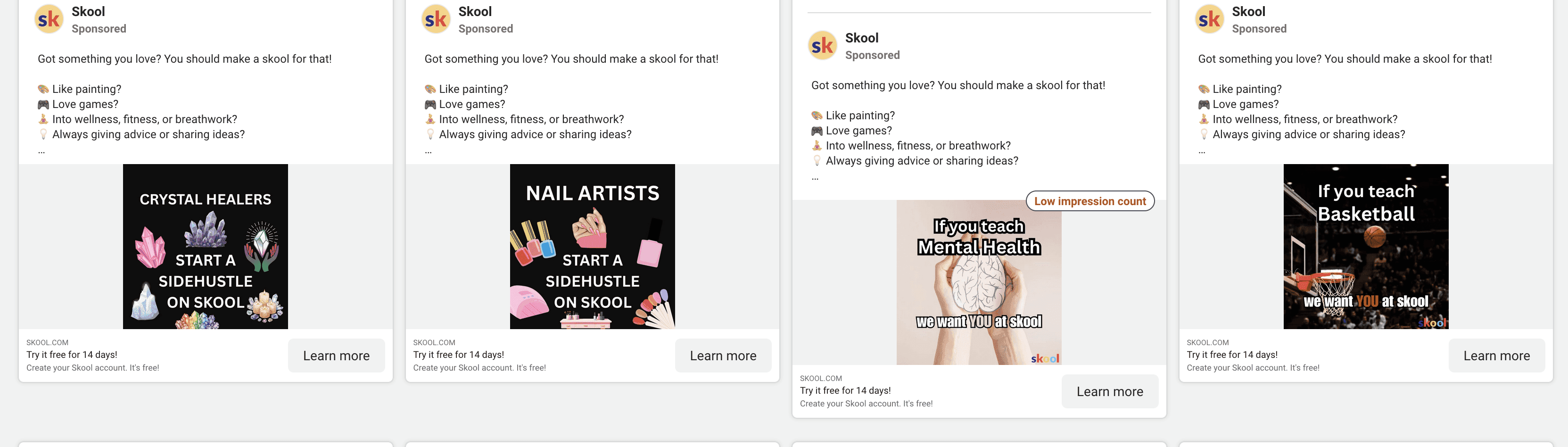
The best way to explain this is with a visual. Here's an example of how Skool uses thousands of variations of their ads with different text on each, calling out their specific audience:
For advertisers, the goal of Facebook Andromeda is simple even if the tech is advanced:
Users see ads that feel more relevant and less annoying.
Advertisers get better returns because the right people see the right creative more often.
Understanding how this “matchmaker” thinks is the first step to real Facebook campaign optimization in this new phase.
Why Meta Built Andromeda The Problems It Was Designed To Solve
Meta did not build Andromeda just for fun. The old system was hitting hard limits that hurt both user experience and advertiser results. Ad volume was exploding while the time allowed to pick an ad for each impression stayed tiny.
Several things came together:
Automation inside Advantage+ campaigns started generating far more ad candidates per auction. One setup could create many audiences and placements.
Generative AI made it cheap and fast for brands to pump out new images, videos, and copy. Meta reported more than fifteen million AI‑generated ads in a single month early on.
The retrieval stage had to scan orders of magnitude more ads than later stages, and it was starting to buckle.
On top of that, the old retrieval design was memory‑heavy and built on many rule‑based shortcuts. It could not use more advanced personalization without blowing past latency limits. That meant Facebook ads optimization hit a ceiling. Campaigns sometimes needed bigger budgets and longer run times just to give the system enough data to settle down.
Advertisers felt this as:
Higher volatility
Odd spending patterns
A sense that Facebook Ads Manager had become harder to “read”
Andromeda was Meta’s way to break through these scaling walls. By rebuilding retrieval around a modern deep learning system and faster hardware, Meta opened the door for deeper personalization and better Facebook ad targeting without slowing the app or burning through compute.
How Andromeda Changed The Facebook Ads Game The Old vs. New Paradigm
The shift to Facebook Andromeda changed how the whole ad stack behaves. To see why old tactics now fail, it helps to compare the previous style with the new one.
The Old System With Limited Personalization And The "Winner Takes All" Approach
Before Andromeda, Meta’s retrieval system was split into many small parts. Each stage had its own rules and models. The system could only add a light layer of personalization at this first step. To control the flood of ads, engineers leaned on hand‑written rules and simple logic.
This is where the “bouncer” image comes from. Once the system saw enough data, it would pick one winning ad inside a set and send nearly all impressions and budget to that version. Other creatives, even good ones, could sit stuck at a few hundred impressions forever. You might have had five ads in a set, but only one really mattered.
The design also hit technical walls. It used a lot of memory bandwidth and could not run in true parallel across modern GPUs. That slowed the roll‑out of new AI ideas and made it hard to scale personalization. Advertisers lived with low flexibility, clunky testing, and frustration when fresh creative seemed to be “left in the dust” without a clear reason.
The New Andromeda System With AI Matchmaking And Dynamic Personalization
Andromeda replaces this with a single, end‑to‑end system tuned for speed and heavy computation. Instead of treating each stage as separate, Meta trains the retrieval model and the way ads are indexed together. This lets the system run far more logic during the same tight time window.
Rather than hunting for one champion ad, Facebook Andromeda behaves like a matchmaker that loves variety. It scans a large, varied set of ad concepts and tries to pair each one with the small audience slice where it fits best. Matching uses many signals at once, including behavior, interests, device, and timing.
Because Andromeda runs on powerful AI hardware with massive parallelism, it can rebuild rich user ad‑interaction features on the fly. Meta has reported:
Around a 6% recall lift at retrieval
Around an 8% gain in ad quality on some segments after rolling it out
The catch for advertisers is that the system now expects a broad mix of creative ideas rather than one polished champion. That change forces a complete rethink of how to build and manage campaigns on the Facebook advertising platform.
The Key Technologies Powering Andromeda's Performance
While Andromeda is very advanced under the hood, a simple picture is enough for day‑to‑day use. Think of three big building blocks working together: a large neural network, a smart way to index ads, and heavy use of GPU power to keep everything fast.
Custom Retrieval Model
The core model is a deep neural network built just for retrieval. It is designed so that adding more capacity does not cause costs to rise at the same rate. Meta has described this as sublinear inference. The system can model many more user interests and creative details without needing a huge jump in hardware.
Layered Ad Index
Ads live inside a layered index instead of a flat list. The model does not have to scan every single creative for each impression. It:
Moves through a structure of clusters
Only drills down into the parts that look promising for this user at this moment
Even better, the index and the model are trained together, so they speak the same “language.” That raises both precision and recall compared with older two‑tower search setups.
GPU‑First Engineering
Andromeda is wired directly into modern GPUs with special code designed to keep data on‑chip as long as possible. It rebuilds user ad‑interaction features in parallel instead of relying on slow, pre‑computed features sitting in CPU memory. Meta has shared that this alone brought:
More than a 100x gain in feature latency and throughput
Over a 3x increase in queries per second at the model level
All of this technical work matters because it gives Facebook Andromeda room to test more creative ideas without wasting spend. Better retrieval means better Facebook ad performance with the same budget, as long as advertisers feed the system the right mix of ads.
Why Your Old Facebook Ad Strategies Are Dead The 3‑2‑2 Method And Incremental Testing
For years, many media buyers swore by the 3‑2‑2 method and similar testing styles. They would launch three creatives, two primary texts, and two headlines, then rotate small tweaks one at a time. This felt like a clean way to see which part of an ad moved the needle.
That style made sense in the pre‑Andromeda world because the system was hunting for one best version. If you had a strong base creative, small changes to hook or headline could bring real gains. Facebook campaign optimization felt scientific: change one thing, hold the rest steady, watch the winner rise.
Post‑Andromeda, this breaks. The retrieval model has strong similarity detection. When you feed it a bunch of ads that look almost the same, it groups them as one concept. Maybe one gets spend and the rest get nothing. That means your “tests” never really run. New creatives can sit at zero impressions, even with solid hooks, because Facebook Andromeda already picked the cousin ad as the concept to try.
This is what people mean when they say the algorithm is “starving.” When you only give it a handful of slight tweaks, the system has no fresh concepts to match with all the micro‑segments inside your broad audience. Many posts from buyers now admit that the old 3‑2‑2 style has stopped working. To improve Facebook ad results going forward, you need a pipeline of truly different ideas, not a pile of tiny changes to the same picture.
The P.D.A. Framework Your Blueprint For Creating Andromeda‑Optimized Ad Concepts
So if small tweaks are dead, how do you build enough variety without burning out? One simple model that works very well with Facebook Andromeda is the P.D.A. framework. That stands for Persona, Desire, and Awareness. When you mix these three, you get a clear map for a steady stream of new concepts.
“If it doesn’t sell, it isn’t creative.”
— David Ogilvy
P For Persona Targeting Specific Situations Not Demographics
Persona is about the “who,” but in a sharper way than old‑school targeting like “women aged 25 to 40.” It focuses on clear situations and pain points. When you write ads for a person in a scene instead of a broad group, tone and visuals change in a natural way.
Take a fitness coach. Instead of one generic ad, you might build creatives for:
An overwhelmed new mom who feels tired and short on time
A desk‑bound executive with back pain and stress
A strapped college student who wants to avoid weight gain without a gym
Each ad can show a different environment and story:
The new mom: short workouts in a messy living room and copy about getting energy back and feeling like herself again
The executive: someone at a standing desk using a simple routine to break up long calls
The student: bodyweight moves and cheap meal ideas that fit a tight budget
You can do the same in SaaS or e‑commerce. A project management app could speak very differently to a founder, a team lead, and a freelancer even if the product is the same. Each persona gets its own language, visuals, and proof. In the context of Facebook Andromeda, each persona acts like its own slot in your creative set, which gives the matchmaker more options to pair with the right users.
D For Desire Tapping Into Core Human Motivations
Desire is the “what” they really want under the surface. Many buying decisions tie back to a few big themes such as health, money, status, and relationships. When you write ads to those deeper drivers instead of only listing features, you get much stronger angles.
Think about that project management tool again:
One ad can speak to status and career growth. It might show a manager hitting every deadline, running clean reports, and getting praise from leadership. The message is that using the tool helps you look like a star and climb the ladder.
Another ad can speak to health and relationships. It could focus on the employee who is tired of late nights and missed dinners. The story is that better planning cuts overtime so they can shut the laptop at five and spend more evenings at home.
Notice that the product has not changed, only the desire angle. When you layer desire on top of persona, you multiply your options. A founder who wants freedom will react to a very different ad than a middle manager who wants a promotion, even if they both live inside the same broad targeting group in Facebook Ads Manager.
A For Awareness Meeting Audiences Where They Are In The Process
Awareness is about where someone is in their buying process. This idea comes from classic copywriting work by Eugene Schwartz and maps very well to Facebook ads strategy. The same offer can feel spot‑on or totally off depending on how aware the viewer is.
You can think in five levels:
Unaware – They do not even see their problem yet. These users need pattern breaks, stories, or stats that make them think about the issue for the first time.
Problem aware – They feel the pain but do not know what to do about it. Ads here should talk more about the pain and hint that there is a better approach.
Solution aware – They know that ways to fix the problem exist but have not settled on a product. Your creative needs to spell out how your way is different from other options.
Product aware – They know your brand but do not fully trust it yet. Here, you lean on case studies, testimonials, and objection handling.
Most aware – They may just be waiting for the right offer or timing. These ads can go straight to the point with a clear deal and call to action.
When you mix Persona, Desire, and Awareness, you get a big grid of possible ideas. A problem‑aware new mom who wants more energy will need a very different ad from a most‑aware executive who wants to sharpen performance. To thrive under Facebook Andromeda, build your creative plan from this grid instead of random one‑off ideas. It gives you a steady, structured way to feed the algorithm varied concepts.
Mastering Creative Diversity Volume Format And Refresh Cadence
Under Andromeda, creative variety is not just helpful. It is mandatory. The algorithm needs a wide bench of distinct concepts so it can test and match them to small audience pockets. A safe rule is to aim for 8–15 clearly different concepts in each ad set, not just light edits of the same base ad.
If you only run three or four similar ads, the system has very little to work with. Spend will pile up on one or two options, and the rest may never exit the learning phase. This feels like erratic delivery and unstable cost per result. When you give Facebook Andromeda a larger, more varied set, it can route each creative to the users who react best and skip the ones who do not.
Format variety matters as much as message variety:
Videos can show product use, stories, or user‑generated content style clips that feel casual and real.
Static images can share clean product shots, lifestyle scenes, or simple charts.
Carousels work well for step‑by‑step demos or full product lines.
Text‑first creatives that use bold words over a plain background can grab attention in placements where people skim fast.
Even the best ad gets tired. People see it, react, and then it stops feeling fresh. To keep Facebook ad performance steady, plan to refresh creative every 7–14 days. That does not mean start from zero each time. Look at which P.D.A. angles are working, then build new concepts that keep the same core idea but with fresh hooks, visuals, or formats. Make this a weekly habit. When creative production becomes an ongoing process instead of a one‑off task, Andromeda has what it needs to keep finding pockets of affordable, high‑quality traffic.
Strategic Campaign Management For The Andromeda Era
Creative is the star now, but campaign structure and money still matter. Facebook Andromeda rewards setups that give it room to learn. That means enough budget, broad signals, and clear feedback at the campaign level.
Modern Budgeting With The 3x Target CPA Rule
A simple way to think about budget is the 3x target CPA rule. Take what you are happy to pay for a purchase or lead and set your daily budget at least three times that number. If your target cost per sale is $50, then a starting daily budget of $150 gives Andromeda enough data to test your creative and find patterns.
Very small budgets struggle in this new world, especially accounts under $500 per day across many campaigns. The system just does not get enough impressions and conversions to read what works. If money is tight, it is better to run one well‑funded campaign than many tiny ones. As performance improves, you can raise spend in steps rather than spreading it thin.
Rethinking Performance Analysis With A Campaign‑Level Focus
The old habit was to watch each ad’s ROAS and kill low performers fast. With Facebook Andromeda, that can backfire. The system might keep one creative on low spend because it knows there is a small but valuable niche that responds to it. Turning that ad off too early can hurt the overall mix.
Shift your focus to campaign and ad set level health. Watch:
Total ROAS
Overall click‑through rate (CTR)
Total conversions and cost per acquisition (CPA)
Outside the ad account, track:
Conversion rate on your landing pages
Customer acquisition cost (CAC) across channels
Media Efficiency Ratio (MER) – revenue divided by ad spend
These numbers tell you if Facebook ads optimization is working for your business, not just inside the platform.
Only cut ads that have had a fair chance. If a creative has enough impressions and its click rate is clearly below your average, or its clicks never turn into conversions, it can go. Leave low‑spend ads that pull their weight on the edge of your data. They may be doing precise work that the top‑line numbers do not show directly.
Intelligent Scaling With Vertical Over Horizontal
In the pre‑Andromeda phase, many buyers scaled by duplicating winning ad sets. That style, often called horizontal scaling, now splits learning across copies and muddies the data pool. The algorithm has to re‑learn the same lessons in each clone, which slows Facebook campaign optimization.
A better fit for Facebook Andromeda is vertical scaling. Once you have a stable, profitable campaign with a strong mix of creative, raise the budget there by 20–30% every few days. Watch how performance reacts at the campaign level before each jump. In parallel, keep adding fresh P.D.A.‑based concepts into the same winning structure.
This approach lets Andromeda keep using all the past data while it searches for more converting users. Many advertisers also see gains from consolidating many small, interest‑stacked ad sets into a few broad ones. Reports of around 17% more conversions with this style are common, because the algorithm can read stronger signals from a larger pool of impressions and events.
How To Use Advantage Plus Tools Without Losing Control
Meta’s Advantage+ tools were built to work hand in hand with Facebook Andromeda. They can handle much of the heavy lifting around audiences, placements, and even certain creative tweaks. Used well, they can raise ROAS without adding a lot of manual work. Used blindly, they can make changes that clash with your brand or your data.
Advantage+ Shopping campaigns are a clear fit for e‑commerce. They spread budget across many placements and use machine learning to find buyers, especially when paired with a rich catalog and strong first‑party signals.
Advantage+ creative tools can auto‑test different crops, formats, and minor text changes to get more from each ad.
The key is to treat these features as a partner, not a boss. Turn on the tools, but review their choices:
Check which auto changes are live before letting them run for long.
Watch performance of automated variations inside Facebook Ads Manager.
If an auto edit hurts CTR or makes your brand look off, switch that option off for future ads.
It also helps to disable any auto settings that keep rewriting your top‑performing ads without clear benefit. You can keep the parts of Advantage+ that handle placements and bidding while keeping full manual control over your core creative. When you mix strong human‑made concepts, broad targeting, and smart use of Advantage+, you give Facebook Andromeda a clear path to improve Facebook ad results at scale.
The Critical Role Of Accurate Event Tracking In The Andromeda Era
Even the smartest retrieval engine can only work from the data it gets. Facebook Andromeda learns what types of people and which creative themes drive sales or leads by watching conversion events. If those events are missing or messy, optimization will wander, no matter how good your ads look.
Tracking has become much harder in the last few years. Browser‑level privacy tools, ad blockers, and the loss of many third‑party cookies all cut into what the classic Facebook Pixel can see. iOS privacy changes made it even worse by blocking a big share of app and web events from Apple devices. For many accounts, reported conversions inside Facebook Ads Manager are far below the real numbers in their store or CRM.
Meta’s answer is the Conversions API, often shortened to CAPI. Instead of sending events only from the browser, CAPI lets your server send purchase, lead, and other key actions straight to Meta. This route is less affected by ad blockers and browser limits, and it supports richer customer data. When set up well, it raises your Event Match Quality (EMQ) score from something like five out of ten to numbers closer to nine or even above.
Higher EMQ means Meta can match more of your conversions back to the right clicks and impressions. That goes straight into better Facebook ad targeting as Andromeda learns which user patterns and creative ideas really drive revenue.
The hard part is setup. Doing CAPI by hand with tools like Google Tag Manager, custom code, and data layers can be slow and technical. Many small teams give up or ship buggy setups that do not help much.
For brands that want strong Facebook ads optimization in the Andromeda phase, fixing tracking is not “nice to have.” It is a base layer. Clean, rich event data plus varied creative gives the algorithm both a clear target and many ways to hit it.
Common Pitfalls And Mistakes To Avoid Post Andromeda Update
When Facebook Andromeda rolled out across accounts from late 2024 into 2025, many advertisers were caught off guard. Some saw sales dip by half or more. Others reported wild swings where a campaign crushed targets one day and burned budget the next.
A lot of this pain came from running old playbooks in a new system. Marketers kept launching a few look‑alike ads, stacking narrow interests, and duplicating ad sets to scale. The algorithm read these as thin creative sets with weak data pools, and performance suffered. Smaller budgets felt this even more because there was not enough volume for Andromeda to see stable patterns.
Here is a quick summary of common traps and better options.
Pitfall | Why It Fails | The Fix |
|---|---|---|
Running three to five very similar ad variations | Andromeda groups close copies and may send spend to only one, so tests never really happen | Build 8–15 clearly different concepts using the P.D.A. framework so each has its own angle |
Over‑segmented interest targeting | Many tiny ad sets split data, and the system works best when it can read broad signals | Combine audiences into a few broad ad sets and let AI find buyer pockets inside them |
Horizontal scaling with cloned ad sets | Duplicates force the algorithm to re‑learn the same lessons, which wastes time and money | Scale by raising budget in proven campaigns while adding new creative into the same structure |
Killing low‑spend ads too fast | Some creatives work for narrow but valuable niches, so spend is meant to be small | Judge success at campaign level and only cut ads that have enough reach and bad click or conversion numbers |
Very small total budgets | Not enough impressions or actions for a complex model to learn from | Start with at least 3x your target CPA as daily budget and grow from there as results improve |
Relying only on remarketing and lookalikes | These older targeting types often under‑perform compared with broad plus signals | Keep them as extra layers but spend most budget on broad campaigns with strong creative variety |
Beyond these structural mistakes, there are odd behaviors to watch. Some advertisers see “ghost approvals” where ads are marked active but never receive impressions. Others see short spikes where Meta spends most of the daily budget in a very short window on one creative. Many of these patterns are signs that the system lacks enough fresh, distinct creative or is restricted by narrow targeting rules.
When things go sideways, start your checkup with two questions:
Do we have at least 8–10 clearly different ad concepts live?
Are we giving Andromeda a big enough, broad enough audience and budget to learn from?
Make those fixes first, then give the campaign 7–14 days before making more big changes. Patience plus smart structure tends to calm even very jumpy accounts.
Step By Step Optimizing Your Facebook Campaigns For Andromeda
It is easy to feel overwhelmed by a big change like Facebook Andromeda, but you do not need to rebuild everything in one night. Follow these phased steps over a few weeks and you will end up with campaigns that fit the new rules.
Phase One – Audit And Restructure
Combine scattered ad sets that all chase the same goal into a few broader ones.
Review your current ads and count how many truly different concepts you are running.
Pause tests that only swap small parts such as headlines while keeping the same core idea.
Adjust budgets so that each main campaign has at least 3x your target CPA as daily spend.
Shift targeting toward broad and Advantage+ style audiences instead of stacked interests.
Phase Two – Build Creative Variety
Use the P.D.A. framework to pick 3–5 personas, a few main desires, and several awareness levels for your product.
Map pairs or trios of these into a concept matrix and aim to fill 10–15 slots with ideas.
For each slot, make at least two formats, such as a vertical video and a static image.
Launch these into your new, consolidated structure and set attribution windows that fit your sales cycle.
Phase Three – Optimize And Scale
Watch campaign‑level metrics rather than single ads.
Note which persona and desire mixes keep winning.
Every 7–14 days, add fresh concepts built on those winning angles and retire the clear under‑performers.
When a campaign holds strong results for a stretch, raise its budget by 20–30% instead of cloning it.
Phase Four – Advanced Tweaks
Test Advantage+ Shopping if you run e‑commerce, or try Advantage+ creative with strict manual checks.
Build a simple content pipeline with your team or partners so that new ads arrive on a steady schedule.
Put proper server‑side tracking in place so Andromeda sees the real conversion picture.
The Future Of Facebook Advertising What Is Next For Andromeda
Meta has made it clear that Andromeda is only the start of a long shift toward heavier AI in its ads stack. One of the next steps on the roadmap is moving the model to what is called an autoregressive loss. In plain terms, that means the system will get better at picking not just a single ad, but smarter sequences of ads over time.
This change should help the model serve a more varied set of ad candidates and avoid showing users the same type of message again and again. That is good news for both users and advertisers. Users get feeds that stay fresh. Brands get more chances to present different angles of the same offer without tiring people out.
Meta also plans deeper ties between Andromeda and its own MTIA chips plus new generations of GPUs. The goal is to raise model complexity by another large factor while keeping speed high. For advertisers, the pattern is clear: automation will handle more of the low‑level work such as targeting and bidding. Human effort will matter most in creative thinking, funnel design, and data quality. Those who learn to work with systems like Facebook Andromeda instead of fighting them will stay ahead.
Conclusion
Andromeda is not just a small update inside Facebook Ads Manager. It is a base‑level change in how Meta picks, tests, and delivers ads. The old playbook of narrow targeting, horizontal scaling, and tiny creative tweaks does not fit this new design. That is why methods like 3‑2‑2 have broken down and why so many advertisers have felt lost.
The new game is clear. To win with Facebook Andromeda, you need a stream of varied concepts, not a stack of look‑alike edits. The P.D.A. framework gives a simple way to build that variety around persona, desire, and awareness. Campaigns should run 8–15 distinct concepts, lean on broad audiences, and focus on campaign‑level metrics and vertical scaling.
This shift does ask more from teams. It means building new creative workflows and trusting AI more with Facebook ad targeting. The reward is real, though. Brands that have adjusted report higher ROAS from Advantage+ campaigns, better conversion rates, and more stable performance once the system has enough data.
That last part is where tracking comes in. Andromeda can only learn from conversions it can see. Many businesses still rely on a weak pixel setup that misses a large share of events. Tools like PixelFlow give a practical way to install Meta’s Conversions API across Webflow, Framer, Squarespace, WordPress, and custom sites without writing code or wrestling with Tag Manager. By sending events from both the pixel and server side and enriching them with extra details, many PixelFlow users see Event Match Quality scores move from around five out of ten to numbers close to nine or higher. Better matching means sharper targeting, lower costs, and stronger Facebook ad performance.
If Facebook Andromeda has shaken your results, the path forward is clear: audit your campaigns against the steps in this guide, commit to real creative variety, and put solid tracking in place. When you feed the system rich, accurate data and a wide set of smart concepts, you give Meta’s AI everything it needs. Your job then becomes what humans do best: set the strategy, craft the stories, and let the machine handle the matching.
FAQs
What Is The Difference Between Meta Andromeda And Facebook Pixel?
Meta Andromeda and the Facebook Pixel sit in very different parts of the ad stack. Andromeda is the brain that decides which ads should be shown to which users. It is the retrieval engine that powers Facebook campaign optimization and Facebook ad targeting.
The Facebook Pixel, on the other hand, is a tracking script on your site that reports actions such as leads and purchases back to Meta. Andromeda depends on clean data from the pixel and Conversions API to learn which impressions turned into sales, then uses that feedback to pick better ad candidates next time.
How Long Does It Take For Campaigns To Stabilize After Optimizing For Andromeda?
Most campaigns need at least 7–14 days to settle after major changes made for Facebook Andromeda. During this time, the system is testing your new creative mix across many micro‑segments. Larger budgets often stabilize faster because the algorithm sees more impressions and conversions each day.
Try not to panic over daily swings during this learning window. Focus on overall trends and campaign‑level results instead of touching bids or budgets every few hours.
Can Small Businesses With Limited Budgets Succeed With Andromeda?
Yes, small businesses can still do well when they use smart structure and creative. Tight budgets do make it harder for Facebook Andromeda to collect data, but you can help by following the 3x target CPA rule and keeping focus on one or two well‑built campaigns instead of many tiny ones.
Use low‑cost production methods such as user‑generated style videos, screen recordings, and simple image ads based on the P.D.A. framework. Combine that with strong tracking and you can still run effective Facebook ads optimization even if your daily spend is under $500.
Do I Need To Use Advantage Plus Campaigns To Work With Andromeda?
You do not have to use Advantage+ campaigns to benefit from Facebook Andromeda. The retrieval engine runs on all campaign types. That said, Advantage+ structures, especially for shopping, are designed to work closely with the new system and often show higher ROAS, sometimes around 20% or more better for new users.
A good move is to test one Advantage+ campaign alongside your regular setups. Keep the core rules the same — broad audiences and rich creative — and compare how each style performs for your store or SaaS offer.
What Is The Biggest Mistake Advertisers Make With Andromeda?
The biggest mistake is running too few real ad concepts. Many accounts still launch three or four ads that all feel like the same idea with slightly tweaked text. Facebook Andromeda groups them together and has almost nothing fresh to match against different audience slices.
The fix is to build 8–15 clearly distinct concepts using the P.D.A. framework and run them inside broad, well‑funded campaigns. A close second error is fighting the algorithm with very narrow, stacked interests instead of trusting broad signals.
How Does Server‑Side Tracking With Conversions API Help Andromeda Performance?
Server‑side tracking through the Conversions API (CAPI) sends conversion events directly from your server to Meta. This path is less affected by ad blockers, browser privacy rules, and iOS limits than the old pixel alone. With better coverage and richer customer data, your Event Match Quality score rises, often from around five out of ten to well above eight.
Higher EMQ means Facebook Andromeda can tie more sales to the right clicks, which sharpens targeting and bidding. The result is better Facebook ad performance, lower costs per result, and more room to scale. Tools such as PixelFlow tracking make this kind of setup far easier by handling the CAPI work without custom code.