Meta’s free one-click setup, or a dedicated tool that sends server-side events to six ad platforms?
Meta’s features were checked in its own documentation on 16 November 2026. Where Meta’s free option is enough, this page says so.


The short answer
Since April 2026, Meta can switch on the Conversions API for your website in one click, for free, using the events your Pixel already sends. PixelFlow is a dedicated tracking tool that sends server-side events to six ad platforms, adds data the Pixel cannot see, and reports on attribution too.
PixelFlow is usually the better choice if you advertise on more than Meta, want leads, bookings and Stripe payments sent with better customer data, or want attribution, bot filtering and an event log in one place.
Meta’s one-click setup may be enough if you only advertise on Meta, your Pixel already tracks the events you care about, and you want server-side events at no cost.
PixelFlow vs Meta’s one-click setup at a glance
PixelFlow Standard against Meta’s free one-click setup. Green means it is handled for you, amber means it is partial or you configure it, grey means it is not available.
 PixelFlow
 Meta one-click
What each tool is
Both send your website events to Meta from a server as well as the browser. Meta’s option does only that. PixelFlow does it for six ad platforms and adds reporting.
Meta’s one-click setup
Meta announced its one-click Conversions API in April 2026. You find it in Events Manager among the setup options for your dataset. Meta describes it as needing no code, configuration or setup fees, with no ongoing maintenance, and it covers website events only.
Meta has two other free routes. Shopify, WooCommerce, Wix and BigCommerce have partner integrations that connect in a few clicks. The Conversions API Gateway runs in your own AWS or Google Cloud account, where you pay the hosting, which Meta estimates at about $13 to $54 a month depending on traffic.
PixelFlow
PixelFlow is a no-code tracking tool. Add one script, choose the events to send, and it sends each one through both the browser pixel and the server-side API of every ad platform you connect: Meta, TikTok, ChatGPT Ads, Snapchat, Pinterest and Reddit.
Deduplication, bot filtering and consent are handled for you, and one dashboard shows attribution, customer journeys and a full event log.
In short: Meta’s one-click setup is a free way to add server-side events for Meta alone. PixelFlow is a full tracking setup for every platform you advertise on, plus the reporting to check it.
Setup
Both can be switched on in minutes. The difference is how much you can control afterwards.
Meta’s one-click setup
Step 1: Make sure the Meta Pixel is installed and sending the events you want.
Step 2: In Events Manager, open Connect data, choose Web and your dataset, then See other ways to set up and Set up with Meta.
Step 3: Confirm, then check your server events and Event Match Quality in Events Manager over the following days.
No settings to change. Meta copies the events and parameters your Pixel already sends. To add customer data, track a new event or send Stripe payments, you need to change your Pixel setup or use another tool.
PixelFlow
Step 1: Add your site and connect your ad accounts in the dashboard.
Step 2: Add one script, or install the plugin for Webflow, Framer, WordPress or WooCommerce.
Step 3: Point and click the buttons, links and forms you want to track with the Visual Tagger, or fire events on page load with a URL trigger, then watch them arrive in the event log.

Pro tip: PixelFlow has an MCP server, so you can ask Claude, Cursor or ChatGPT to install the script and set up your events for you.
Verdict: Meta wins on effort if Meta is your only platform and your Pixel is already right. PixelFlow wins if you want to choose what gets sent, or need it on other platforms too.
Ad platforms and integrations
This is the simplest section: Meta’s option only sends to Meta.
Meta’s one-click setup
One-click CAPI and the Conversions API Gateway send events to Meta only. Meta’s Signals Gateway, which you host yourself, can also send data to your own endpoints or BigQuery, but not to other ad platforms.
PixelFlow
PixelFlow sends to six ad platforms. Plans include one, three or five of them, and extra platforms cost $10 a month each.
Google Ads and GA4: neither PixelFlow nor Meta’s option sends to Google. For Google, use Google’s own tags or a tool built around them.
Where PixelFlow goes deeper is the website side: one-script installs for Webflow, Framer, Squarespace, WordPress, WooCommerce, Kajabi, ClickFunnels, GoHighLevel and plain HTML, plus built-in Stripe and Calendly integrations that send payments and bookings from a webhook, matched back to the ad click.
Verdict: PixelFlow wins if you advertise anywhere other than Meta. If you only run Meta ads, this section does not matter to you.
Attribution and customer journeys
Sending events to Meta is half the job. The other half is checking what Ads Manager tells you.
Meta’s one-click setup
Meta’s option adds no reporting of its own. You see results in Ads Manager, which reports on Meta’s ads using Meta’s attribution settings. Meta says businesses using the Conversions API for web see an average 17.8% lower cost per result.
There is no view across your other ad platforms, and no customer journey showing every visit before a sale.
PixelFlow
PixelFlow uses the same events it sends to the ad platforms to build its own attribution. The attribution table lists every source, campaign and ad with visitors, sessions, leads, purchases and revenue, so you can check Ads Manager against what actually happened on your site.
Open any purchase or lead and you get the journey behind it: the ad they clicked first, every page they viewed, the days between visits and the event that converted them.

One limit: PixelFlow's attribution covers traffic to sites running its script. It does not reconcile ad spend across channels the way a dedicated attribution platform does.
Verdict: PixelFlow wins. Meta’s option improves the data Meta receives, but it does not give you an independent view of which ads drove each sale.
Data quality
Both send server-side events that Meta deduplicates against the Pixel. The difference is what data goes with them.
Deduplication
Meta says events from the one-click setup are deduplicated automatically. PixelFlow generates one event ID for both the browser and server copy of every event, so each platform counts it once with nothing to configure.
Watch this when switching: if Meta’s one-click setup and PixelFlow both send server events for the same pixel, check Events Manager for duplicates and turn one of them off.
Bot filtering and blocking rules
Meta’s documentation for these options does not mention bot filtering.
PixelFlow drops crawlers, scrapers and other automated traffic before anything reaches an ad platform, and blocking rules let you stop a repeat of the same event within a set time, block events with no click ID, or block by URL or referrer.
Event logs
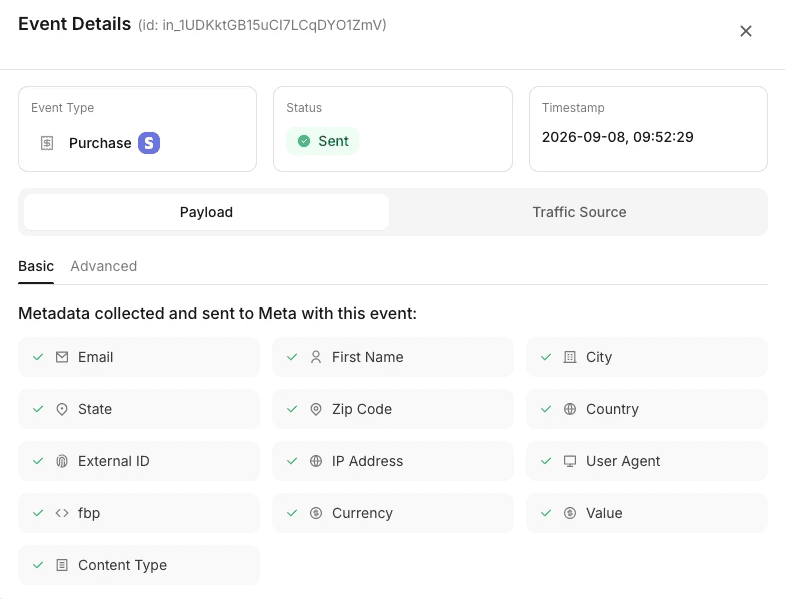
Match quality
PixelFlow attaches the browser and click identifiers, IP address, user agent, a hashed location and an anonymous external ID to every event automatically, and captures email, phone and name from tagged forms or URL parameters. Meta’s one-click setup sends what your Pixel already collects, so adding customer data means changing your Pixel setup.
Verdict: PixelFlow wins on match quality and visibility. Meta’s option is fine if your Pixel already sends rich customer data.
Consent and privacy
Meta’s one-click setup
Meta’s option does not include a consent tool. Meta says its existing consent rules and Business Tools terms still apply, so consent depends on how your Pixel is set up behind your cookie banner.
PixelFlow
PixelFlow reads the choice from the banner you already use, including CookieYes, Cookiebot, Complianz, OneTrust and any banner that supports Consent Mode v2. Tracking runs when a visitor accepts and stays off when they decline.
Global Privacy Control and Do Not Track are honoured, even over an Accept click
Custom banners connect with one line of code
Consent mode is on by default for every site
Either way: making sure your site complies with the law is still your responsibility. The tools help you respect choices; they do not make the site compliant on their own.
Verdict: PixelFlow wins on effort. It reads your banner and honours Global Privacy Control by default. With Meta’s option, consent is handled by your existing Pixel setup.
Pricing
Meta’s one-click setup is free. PixelFlow charges a flat price per site with unlimited events. Meta’s options were checked in its documentation and PixelFlow’s prices on its site on 16 November 2026.
PixelFlow
Meta’s options
On price alone Meta’s option is hard to beat. What you pay for with PixelFlow is the other ad platforms, the extra data and the reporting.
Verdict: Meta wins on price. PixelFlow is worth paying for when you advertise on more than Meta, or want better data and your own reporting.
Which should you choose?
There is no universal answer. It comes down to how many platforms you advertise on and how much you need to see.
Choose PixelFlow if
You advertise on TikTok, Snapchat, Pinterest, Reddit or ChatGPT Ads as well as Meta
You want leads, bookings and Stripe payments sent server-side
You want more customer data on each event for better match quality
You want attribution and customer journeys across your ad platforms
You want bot filtering and a full event log
Stay with Meta’s one-click setup if
You only advertise on Meta
Your Pixel already sends the events and customer data you need
You run Shopify, WooCommerce, Wix or BigCommerce and use the free partner integration
You are happy with the reporting in Ads Manager
You want server-side events at no cost
Final verdict: Meta’s one-click Conversions API is a good free upgrade for Meta-only advertisers whose Pixel is already set up well. PixelFlow is a full tracking and attribution tool for every platform you advertise on. If you run ads beyond Meta or want to see what is actually working, PixelFlow is usually the better choice.
SWITCHING
Move from Meta’s one-click setup in three steps
Run PixelFlow on the same pixel, check the events in the log and in Events Manager, then turn off the one-click setup so only one server source remains. Most sites are done in under fifteen minutes.
“After implementing PixelFlow with CAPI, we started seeing significantly more conversion events registered in Meta than we got with the pixel alone. Our TrialStarted event match quality jumped almost immediately from 4/10 to 8.5/10.”

Mike Flieder
Founder & CEO, SimpleCheck

Smarter, server-side tracking
Start sending accurate conversions today - no tag manager, no code, no developer required.
Compatible with


