
The 10 Best Tracklution Alternatives for 2026 (Fairly Compared)

Last updated 28 July 2026
•
11 min read
Tracklution does one thing well: it puts server-side tracking in front of marketers who never wanted to touch a tagging server. People start shopping for a Tracklution alternative when the meter starts running, when a second website needs its own subscription, or when the tracking logic they need turns out to sit just outside what a managed connector can express. This guide covers ten realistic options, compared fairly against the same criteria.
“We’re on Tracklution’s Grow plan and the overage line is now bigger than the subscription. What do people move to?”
Disclosure: PixelFlow is our product. It appears below as one of ten options, assessed against the same criteria as everyone else, and it is the wrong choice for anyone who needs more than Meta.
TL;DR: Tracklution alternatives at a glance
There is no single best Tracklution alternative, because Tracklution bundles three separate jobs: collecting events without code, routing them to a dozen ad platforms, and hosting the whole thing in the EU. Which of those you are actually replacing decides where you land. If Meta is the only platform you meaningfully spend on, a focused no-code tool like PixelFlow (our tool) removes the metering problem entirely.
If you need the multi-platform routing, WeTracked is the closest managed swap, and Stape, Addingwell and Taggrs hand you back full control of server-side GTM. Elevar owns Shopify, Hyros owns paid-media attribution, JENTIS answers to compliance teams, and Cloudflare Zaraz is close to free if your traffic already passes through Cloudflare. Where each one fits, and what it costs, is below.
Tool
Best For
Starting Price
Pros
PixelFlow (our tool)
Meta-only advertisers on site builders who want unlimited events
From $29/€29/mo
No-code Visual Tagger, unlimited events, pixel + CAPI auto-dedup
WeTracked
Shopify and WooCommerce brands wanting multi-platform coverage
From $49/mo
Multi-platform delivery, data enrichment, 5-minute setup
Addingwell
Teams moving to sGTM who want premium managed hosting
Free (100k req); €90/mo
EU infrastructure, monitoring, human support, CDN included
Taggrs
Agencies and budget-conscious sGTM users
Free (10k req); ~€22/mo
Cheapest paid sGTM tier, Meta CAPI Gateway, ISO 27001
Stape
The default sGTM host, widest template library
Free (10k req); from $20/mo
80+ templates, Meta CAPI Gateway, huge community
Elevar
Shopify stores needing order-accurate ecommerce tracking
Free tier; from ~$200/mo
Shopify-native data layer, order-level accuracy
JENTIS
Enterprises where legal signs off on the tracking stack
Custom; contact sales
Compliance-first, EU processing, enterprise support
Quick verdict: the best Tracklution alternative
If your paid media is Meta and your site runs on a builder like Webflow, Squarespace, Framer or WordPress, PixelFlow (our product, best for that use case) is the cleanest escape from event metering: point-and-click events delivered through both the pixel and the Conversions API, unlimited events on every plan, from $29/€29/mo.
If the multi-platform routing is what you are actually paying for, WeTracked is the closest managed like-for-like, and Stape, Addingwell or Taggrs hand you back the full flexibility of server-side GTM if you are willing to own the configuration.
Beyond that, pick by the shape of the problem: Elevar for Shopify order accuracy, Hyros when attribution matters more than delivery, JENTIS when legal has a veto, Zaraz when your traffic already runs through Cloudflare, and self-hosted sGTM when you want no vendor at all.
What is Tracklution? (And why look for an alternative?)
Tracklution is a Finnish server-side tracking platform that sits between your website and your ad platforms. You install a script (or the Shopify app, or the WooCommerce plugin), point it at a first-party CNAME subdomain, and switch on connectors for Meta, Google Ads, TikTok, LinkedIn, Microsoft Ads, Snapchat, Pinterest, Reddit, Klaviyo, GA4 and more. There is no server-side GTM container to build, which is exactly the appeal: the company quotes a 16-minute median implementation time and a free tier at 5,000 events a month.
The catch is the pricing model and the scope. Tracklution meters events rather than server requests, so the bill tracks your traffic directly. Both the free plan and the €39/mo Grow plan cover a single website. And anything genuinely custom, unusual identity stitching, conditional routing, event logic no connector exposes, still points back toward a tagging server. Those three gaps (metered events, one site per plan, and connector-shaped limits) are what the alternatives below compete on.
Tracklution at a glance
Core use
Managed server-side tracking from a website to 13+ ad and analytics platforms
Best for
Marketers and small teams who want server-side tracking without owning a tagging server
Key features
No-code setup, first-party CNAME collection, offline conversions, consent mode, attribution engine, EU hosting
Pricing
Free (5,000 events/mo); Grow €39/mo billed annually (50,000 events, 1 site); Enterprise and Agency quoted
Main limits
Events metered at €0.0008 each past the allowance; one website per Free/Grow plan; connector-shaped, not a tag manager
Hosting
EU, Helsinki-headquartered with a New York office
Server-side tracking: sending conversion events from a server to an ad platform’s API, such as Meta’s Conversions API, instead of relying on a browser pixel that ad blockers and browser privacy settings can drop. Deep dive: how the Conversions API works.
Why look for a Tracklution alternative?
To be clear: Tracklution is a good product and the setup really is fast. These are the five reasons people genuinely move.
The event meter. Grow includes 50,000 events a month and charges €0.0008 for each one after that. A store doing 50,000 sessions with five tracked events apiece lands around 250,000 events, which is roughly €199/mo on paper. Traffic growth turns into a tracking invoice.
One website per plan. Free and Grow both cover a single site. Running five brands, or five client sites, means five subscriptions or a quoted Agency plan.
You only advertise on one platform. Tracklution’s core value is routing to a dozen destinations. If your entire budget sits in Meta Ads, you are paying for reach you never use.
You need logic a connector does not expose. Managed connectors trade flexibility for simplicity. Custom identity stitching, conditional routing and unusual event shapes still land more naturally in server-side GTM.
Ecommerce-specific accuracy. Shopify and WooCommerce stores that need order-level reconciliation, refunds and subscription events often want a purpose-built ecommerce tracking layer rather than a general connector.
Signs you should look beyond Tracklution
Your overage line has overtaken your subscription line.
You manage more than one website, or more than one client.
Meta is the only platform you meaningfully spend on.
Someone on your team already knows GTM and would rather own the configuration.
Finance or legal wants a named data-processing region and an enterprise contract.
What Tracklution actually costs at volume
Tracklution’s headline price is €39/mo, which is fair for a small site. Because it meters events rather than server requests, the number that matters is how many events your site fires, not how many people visit it. Here is what the published Grow rate (€39/mo billed annually, 50,000 events included, €0.0008 per extra event) works out to as traffic grows.
Events per month
Overage
Approximate monthly cost
50,000 (included)
None
€39
150,000
100,000 x €0.0008
~€119
300,000
250,000 x €0.0008
~€239
500,000
450,000 x €0.0008
~€399
1,000,000
950,000 x €0.0008
~€799
Two things follow. First, event-metered pricing bills hardest exactly when the business is doing well, and a single misconfigured trigger firing on every page view can double the invoice. Second, none of those figures cover a second website. For comparison, PixelFlow charges $29/€29/mo for one site, $79/mo for five and $149/mo for ten, with unlimited events on every tier, because it only has one platform to deliver to. Confirm current numbers on Tracklution’s pricing page before you budget; pricing is the element that stales fastest.
How we compared these alternatives
Every option is judged on the same four criteria, weighted equally: setup effort (how quickly a marketer gets reliable events flowing), capability (platforms covered, event flexibility, data quality controls), pricing value (what you actually pay at real small-business volumes, overages included), and support (how much help arrives when tracking breaks).
Each entry describes fit for the audience named in it, not a universal ranking. We have an obvious interest here: PixelFlow is our product, so we do not rank it against the others. We do state plainly where it loses, chiefly that it only serves Meta. Where it is the wrong answer, the entry says so.
The categories, at a glance
The ten tools below fall into five groups, and most people only need to shortlist inside one of them. Two of those groups replace Tracklution directly; the other three are for cases where Tracklution was never quite the right shape in the first place.
Category
Tools
Best for
No-code managed tracking
PixelFlow, WeTracked
Leaving Tracklution without taking on a tagging server
Server-side GTM hosting
Stape, Addingwell, Taggrs, self-hosted sGTM
Trading setup effort for total control over tracking logic
Ecommerce specialists
Elevar
Shopify and WooCommerce stores needing order-accurate data
Attribution platforms
Hyros
High ad spend where the question is credit, not delivery
Enterprise and edge
JENTIS, Cloudflare Zaraz
Compliance-led procurement, or near-free delivery at the edge
The 10 best Tracklution alternatives in 2026
PixelFlow
Best for Facebook ads with unlimited tracking (disclosure: our tool)
Best for: Meta-only advertisers on Webflow, Squarespace, Framer, WordPress or WooCommerce who want server-side tracking with no event ceiling.
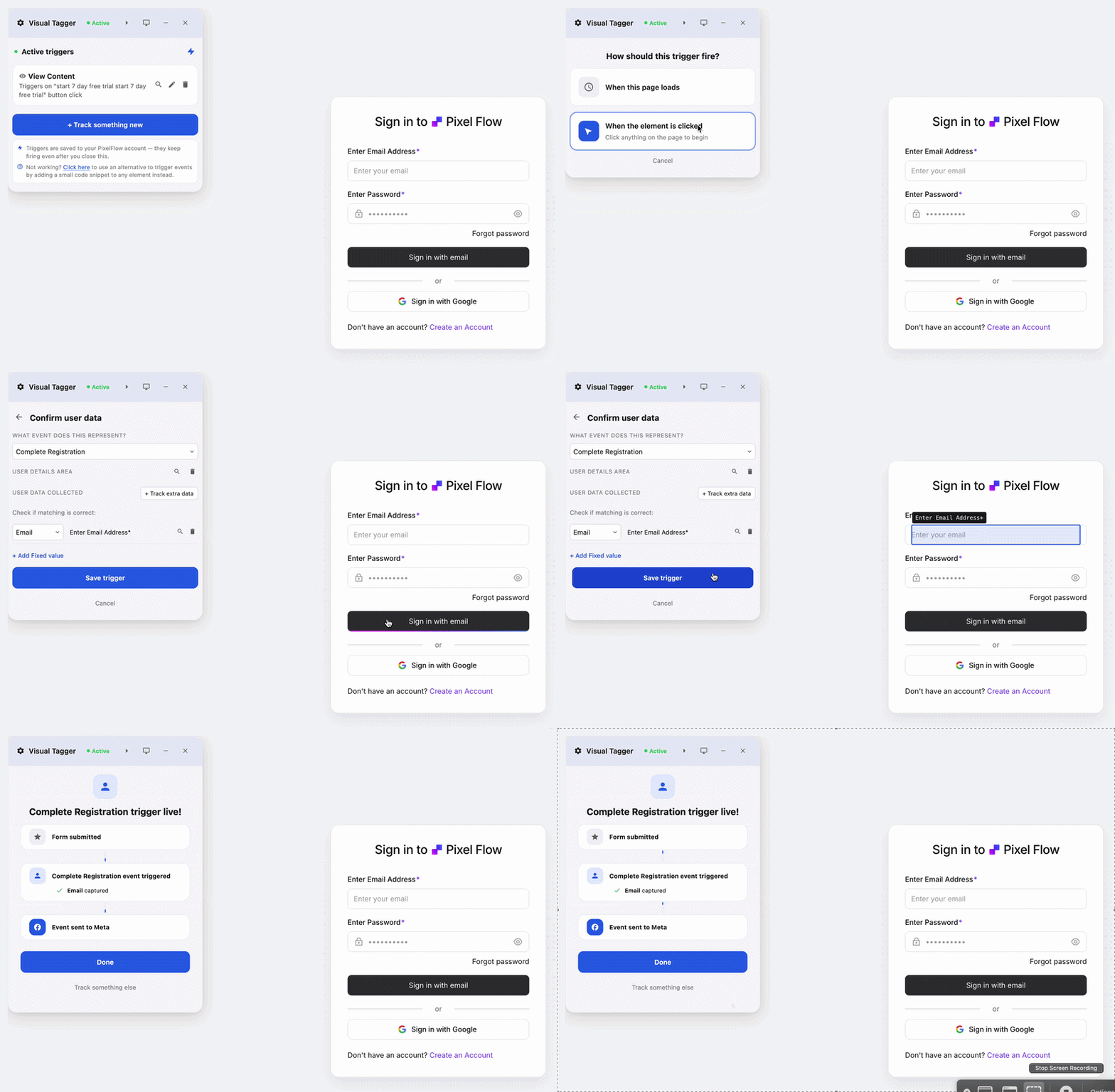
PixelFlow narrows the problem to one platform and solves it completely. Events are created with a point-and-click Visual Tagger or URL triggers, then sent through both the browser pixel and Meta’s Conversions API with a shared event ID so deduplication is automatic. Every event carries the match data that lifts event match quality (fbp, fbc, IP, hashed customer data where you map it), and Stripe and Calendly webhooks capture conversions that happen off your site. Events are unlimited on every plan, so the bill does not move when traffic does.
Honest limits: PixelFlow is Meta-only. Google Ads, TikTok, LinkedIn and the rest of Tracklution’s connector list are not on the roadmap today, so if multi-platform routing is why you bought Tracklution, options 2 to 10 fit better. It is not a tag manager either: no custom non-standard events, no CRM sync, no custom tracking domain and no cross-origin iframe tagging. As the publisher, we do not rank our own tool; treat this as a disclosed house pick.
Pricing: Starts at $29/mo for 1 site with unlimited events and pixels on every tier, 7-day free trial.
WeTracked
Closest managed like-for-like for ecommerce brands
Best for: Shopify and WooCommerce brands that want Tracklution’s multi-platform delivery with heavier data enrichment.
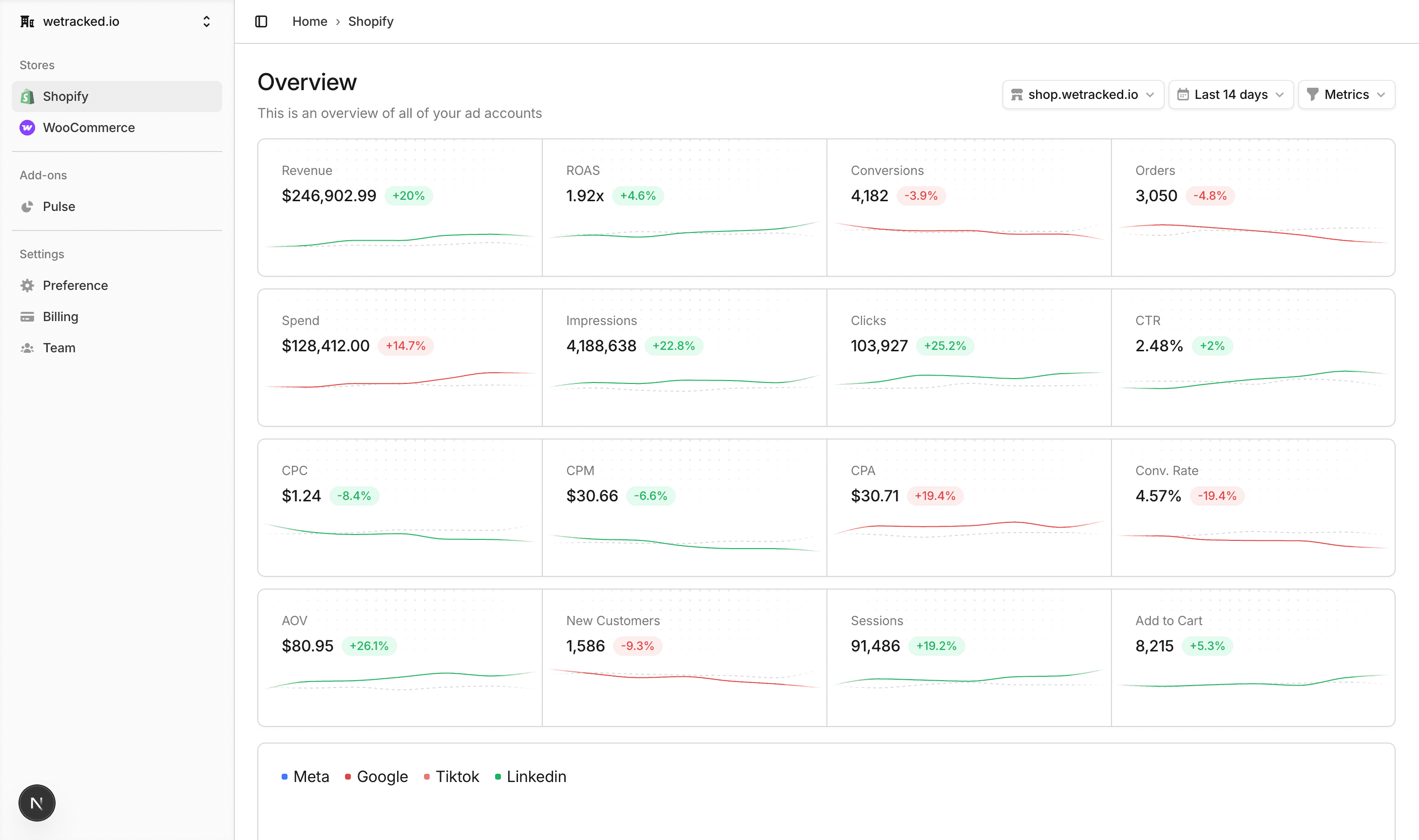
WeTracked is the nearest thing to a straight swap: server-side tracking that rebuilds conversion data lost to ad blockers and browser restrictions, then pushes it to Meta, Google, TikTok and the other major ad platforms. Setup is quoted at around five minutes with no code, and the pitch centres on its data enrichment engine and event filtering rather than on handing you a tagging server.
Honest limits: it starts at $49/mo, above Tracklution’s Grow tier, and it is squarely aimed at ecommerce, so lead-gen and SaaS sites get less out of the store-specific machinery. Like Tracklution it is a managed connector product, so genuinely custom logic still belongs in sGTM. We compare it directly in ourWeTracked alternative breakdown.
Pricing: Starter $49/mo, Business $149/mo, Scale-up $249/mo, Enterprise custom. 14-day free trial.
Addingwell
Addingwell - Best premium managed sGTM hosting
Best for: teams willing to move to server-side GTM who want premium managed hosting, monitoring and real human support.
Addingwell hosts your server-side GTM container on EU infrastructure with a global CDN for your tag scripts, proactive monitoring, and support by email, chat and phone from people who genuinely understand tagging. Only incoming container requests count toward billing, which keeps invoices predictable in a way event metering does not.
Honest limits: this is a step up in workload, not down. You leave a no-code product and take on containers, clients, tags, triggers and manual deduplication, and it is premium-priced next to Taggrs.
Pricing: free plan up to 100,000 requests/mo; paid from €90/mo for 1M requests; add-ons for extra containers (€30/mo), domains (€10/mo) and regions (€20/mo).

Taggrs
Best value sGTM hosting with a free tier
Best for: agencies and budget-conscious teams who want cheap, solid sGTM hosting with an EU footprint and a container per client.
Taggrs undercuts most sGTM hosts: a free tier, then paid plans that scale by request volume rather than by event. It runs on European infrastructure (UpCloud), is ISO 27001 certified, and bundles extras most hosts charge for: a Meta CAPI Gateway, cookie recovery, PII anonymisation and data enrichment. For an agency juggling client sites, one hosting account beats one Tracklution subscription per brand.
Honest limits: like every sGTM host it still requires GTM knowledge, and a dedicated account manager only arrives on the top tier.
Pricing: free (10,000 requests/mo); Basic ~€22/mo (750k); Pro ~€57/mo (3M); Ultimate ~€127/mo (10M); Enterprise custom. Annual billing saves 13%.

Stape
Stape The default server-side GTM host
Best for: teams that want the largest sGTM ecosystem, the widest template library and the biggest community behind it.
Stape is the most popular hosting provider for server-side Google Tag Manager, with a free tier, paid hosting from around $20/mo, and 80+ tag templates plus gateways for Meta, TikTok and Snapchat. If you are leaving Tracklution because a connector could not do what you needed, Stape is where that flexibility lives, and there is a tutorial for nearly every scenario.
Honest limits: hosting the container is the easy part. You still build and maintain everything inside GTM, deduplication is yours to configure, and costs scale with request volume as traffic grows. We cover the trade-off in our Stape alternatives guide and the PixelFlow vs Stape head-to-head.
Pricing: free tier around 10,000 requests/mo; paid hosting from roughly $20/mo, scaling by request volume; power-ups and gateways priced separately.

Elevar
Best for Shopify order accuracy
Best for: Shopify and Shopify Plus stores where tracking has to reconcile against actual orders, refunds and subscriptions.
Elevar is a Shopify-native data layer and server-side tracking product rather than a general connector. It builds a consistent data layer across the storefront and checkout, then forwards enriched, order-accurate conversions to Meta, Google, TikTok and Klaviyo. For stores where a 3% discrepancy between Shopify and Ads Manager causes an argument every month, it is the tool built for that argument.
Honest limits: it is priced on monthly order volume and gets expensive quickly, and it is Shopify-shaped, so lead-gen sites, SaaS and non-Shopify ecommerce get much less from it.
Pricing: free starter tier; Essentials around $200/mo (1,000 orders), Growth $450/mo (10,000 orders), Business $950/mo (50,000 orders), with per-order overages. Confirm on Elevar’s pricing page.

JENTIS
Best enterprise, compliance-first platform
Best for: enterprises where GDPR, data residency and legal sign-off drive the tracking architecture.
JENTIS is a server-side data capture platform built compliance-first: EU processing, consent-aware data streams, and enterprise onboarding that replaces the DIY parts of sGTM with a managed product. It targets organisations where the data protection officer has a seat at the tooling decision, which is a very different buying committee to the one that signs up for a €39 plan.
Honest limits: it is an enterprise purchase with custom pricing and procurement cycles; small teams will find options 1 to 6 faster and cheaper.
Pricing: custom. JENTIS packages the platform as Core, Professional and Enterprise tiers, all quoted by sales.

Cloudflare Zaraz
Best edge option if you already use Cloudflare
Best for: sites already behind Cloudflare that want faster pages and basic server-side event delivery without another vendor or another invoice.
Cloudflare Zaraz loads third-party tools at the edge instead of in the browser: you configure tools like the Meta pixel and Conversions API or GA4 in the Cloudflare dashboard and Zaraz fires them from Cloudflare’s network. Every account includes 1,000,000 Zaraz events free per month, then $5 per additional million. Set against Tracklution’s €0.0008 per extra event, that is roughly 160 times less per event, though the two products do very different amounts of work for it.
Honest limits: your site must run through Cloudflare, the tool catalogue and event flexibility are narrower than GTM’s, and complex ecommerce setups outgrow it quickly.
Pricing: 1M events/mo free on every Cloudflare plan; $5 per additional 1M events.

Hyros
Best when attribution matters more than delivery
Best for: high-spend advertisers and info-product businesses where the real question is which ad created the sale, not whether the event arrived.
Hyros is an attribution platform first and a tracking pipe second. It stitches long, multi-touch buying journeys together, including phone calls and offline closes, and reconciles them against ad spend so you can compare reported ROAS with tracked revenue. If you left Tracklution because you still could not answer “which campaign actually produced this customer”, Hyros aims at exactly that gap.
Honest limits: it is the most expensive option here by a wide margin, priced on tracked revenue rather than events, with no self-serve signup, and it is overkill for anyone spending less than five figures a month. More detail in our Hyros alternative comparison.
Pricing: from roughly $230/mo billed annually at the entry revenue tier, rising steeply with tracked revenue; demo required.

Self-hosted sGTM on Google Cloud
Maximum control for engineering teams
Best for: engineering teams that want full control and no tracking vendor at all.
Google documents how to deploy the server-side GTM container on Cloud Run or App Engine yourself. You control regions, scaling and logs, and pay only cloud fees, typically around $40/mo for a minimal setup and $120+/mo for a production-grade, multi-instance deployment. There is no per-event meter of any kind.
Honest limits: you own uptime, updates, cost monitoring and debugging forever, and that time usually costs more than any host’s subscription. It is the furthest possible move from what Tracklution sells.
Pricing: no licence fee; cloud costs of roughly $40-150+/mo plus engineering time.
Start scaling your ads with better data
No credit card required
5-minute setup
Which should you choose?
Meta-only on a site builder, tired of the event meter: PixelFlow.
Shopify or WooCommerce brand needing multi-platform delivery: WeTracked.
Willing to run sGTM and want premium managed hosting: Addingwell.
Running client sites on a budget: Taggrs.
Want the biggest sGTM ecosystem and template library: Stape.
Shopify store that needs order-accurate reconciliation: Elevar.
Legal or procurement drives the decision: JENTIS.
Already behind Cloudflare with simple needs: Cloudflare Zaraz.
Spending heavily and arguing about attribution, not delivery: Hyros.
Engineering team in-house that wants no vendor: self-hosted sGTM on Google Cloud.
How to switch from Tracklution
Inventory what Tracklution is actually sending. Open your connector list and note every event, every destination, and which ones your ad platforms optimise against. Most accounts use far fewer than they pay for.
Install the replacement alongside it. Both tools can run at once. Server events deduplicate against the browser pixel by event ID, not against each other, so expect some temporary double counting in Ads Manager.
Rebuild your highest-value event first: Purchase or Lead, verified in Meta Events Manager’s Test Events before you touch anything else.
Compare 48 hours of volume side by side. Event counts should land within a few percent. Meta can take up to 48 hours to attribute, so do not judge on the first afternoon.
Cut over and cancel. Turn off the Tracklution connectors, confirm a full day of clean solo data, then cancel before the next renewal date. Budget about an hour for a single site.
Keep the Tracklution account live until you have a full week of clean data on the new tool. €39 is cheaper than a gap in your conversion history.
Final verdict
Tracklution built a genuinely good on-ramp to server-side tracking, and for a single site advertising across several platforms it remains an easy recommendation. The reasons to leave are structural rather than qualitative: events are metered, plans cover one website, and connectors can only do connector-shaped things. Match the replacement to whichever of those actually bites. If it is the meter and you only run Meta, a flat-priced single-platform tool ends the problem. If it is the ceiling on flexibility, server-side GTM is where you were always heading. The best Tracklution alternative is the one that removes the constraint you keep hitting.
Key takeaways
Tracklution meters events at €0.0008 each past your allowance, so the bill grows with your traffic. That is the single most common reason people shop for alternatives.
Free and Grow plans cover one website each, which sends agencies and multi-brand operators looking elsewhere first.
Ten realistic alternatives across five categories: no-code managed (PixelFlow, WeTracked), sGTM hosting (Stape, Addingwell, Taggrs, self-hosted), ecommerce (Elevar), attribution (Hyros), enterprise and edge (JENTIS, Cloudflare Zaraz).
Every option is judged on setup, capability, value and support. Fit beats ranking, and PixelFlow is Meta-only, so it is the wrong choice whenever you need multi-platform delivery.
Free tiers exist across the board: Tracklution (5k events), Taggrs and Stape (10k requests), Addingwell (100k requests), Cloudflare Zaraz (1M events).
More tracking comparisons: PixelFlow vs Stape head-to-head · Facebook Event Setup Tool alternatives · WeTracked alternative · Hyros alternative · PixelYourSite alternative · Stape alternatives. New to server-side tracking? Start with server-side tracking vs the pixel and why you need the Conversions API.
Frequently Asked Questions
What is the best Tracklution alternative?
It depends which part of Tracklution you are replacing. If you advertise on Meta only and the event meter is the problem, PixelFlow (our product) delivers pixel plus Conversions API events with unlimited volume from $29/€29/mo. If you need the multi-platform routing, WeTracked is the closest managed swap for ecommerce brands. If you want flexibility a connector cannot give you, Stape, Addingwell and Taggrs put you back in server-side GTM with full control over the logic.
Why do people leave Tracklution?
Four reasons come up repeatedly. The event meter, because Grow includes 50,000 events a month and charges €0.0008 for each one after that, so the bill tracks traffic. The one-website limit on the Free and Grow plans, which pushes agencies and multi-brand operators into quoted plans. Paying for thirteen destinations while advertising on one. And hitting the edge of what a managed connector can express, at which point a tagging server is the honest answer.
How much does Tracklution actually cost?
The free plan covers 5,000 events a month on one website. Grow is €39/mo billed annually (€468 up front) for 50,000 events on one website, with 12 months of data retention. Past that allowance, extra events cost €0.0008 each, so 300,000 events a month works out around €239 and a million events around €799. Enterprise and Agency plans are quoted by sales. Check Tracklution's pricing page before budgeting, since these numbers move.
Is Tracklution worth it?
For a single website advertising across several platforms, yes. Setting up server-side delivery to Meta, Google Ads, TikTok and LinkedIn from one dashboard, with first-party CNAME collection and consent handling included, is worth more than €39 a month, and the setup genuinely is fast. It stops being worth it in three situations: when monthly event volume pushes the overage line past the subscription, when you need the same tracking on several sites, and when your spend is concentrated on one ad platform, at which point you are paying for breadth you never use.
Can I get server-side tracking without Google Tag Manager?
Yes, and that is exactly what Tracklution and its closest alternatives sell. PixelFlow handles the Meta pixel and Conversions API with point-and-click setup and no containers at all, and WeTracked does the same across multiple ad platforms for ecommerce stores. Cloudflare Zaraz configures tools at the edge from the Cloudflare dashboard. The GTM-free route trades away conditional logic and custom event shapes, which is precisely the trade the four sGTM options on this list refuse to make.
Do these alternatives support the Facebook Conversions API?
All ten can deliver Meta CAPI events, in different ways. PixelFlow and WeTracked do it natively as their core product. Stape, Addingwell, Taggrs and self-hosted sGTM do it through your GTM configuration, with Stape and Taggrs also offering a Meta CAPI Gateway. Elevar sends order-accurate Shopify conversions, JENTIS routes through its enterprise connectors, Hyros ships its own Meta integration, and Zaraz has a Facebook tool in its catalogue. Deduplication against the browser pixel is automatic in the managed tools and something you configure by hand in the sGTM routes.
Is there a free Tracklution alternative?
Several, with real limits. Taggrs and Stape both host server-side GTM free up to around 10,000 requests a month, Addingwell free up to 100,000 requests, and Cloudflare Zaraz includes 1,000,000 events a month on every Cloudflare plan, which is the most generous free tier in this comparison by a wide margin. Meta's own one-click Conversions API in Events Manager is also free, but it only mirrors what your browser pixel already captured, so treat it as a supplement rather than a replacement. PixelFlow has a 7-day trial rather than a free tier.
Is PixelFlow a replacement for Tracklution?
For Meta-only advertisers, yes, and usually a cheaper one: pixel plus Conversions API with automatic deduplication, unlimited events on every plan, and 5 or 10 sites on the higher tiers rather than one. It is not a replacement if Google Ads, TikTok, LinkedIn or GA4 delivery is part of why you bought Tracklution, because PixelFlow does not send to any of them. Disclosure: PixelFlow is our product, which is exactly why that limit is stated this bluntly.
Does PixelFlow do everything Tracklution does?
No. Tracklution reaches thirteen-plus ad and analytics destinations, uploads offline conversions from a CRM, and includes an attribution engine on the Grow plan. PixelFlow does none of those things. What it does instead is remove the event meter and the one-site limit for the Meta use case, and make setup a point-and-click job on site builders. If breadth is what you need, Tracklution is the better buy, and saying so is more useful than selling you the wrong tool.
How do I switch from Tracklution without losing conversion data?
Run both in parallel for a few days. Install the new tool alongside Tracklution, rebuild your most important event first (usually Purchase or Lead), and verify it in Meta Events Manager's Test Events. Compare 48 hours of event volume between the two before switching anything off, allowing for Meta taking up to 48 hours to attribute. Then disable the Tracklution connectors, confirm a clean day of solo data, and cancel before renewal. Historical conversions already reported to your ad platforms stay in those platforms; you are only changing how new events arrive.
See how PixelFlow can help your business
 Ask ChatGPT
 Ask Gemini
 Ask Claude
 Ask Perplexity